Open the App Store, search "daily affirmations," and you'll find a thousand apps that promise more or less the same thing: a card with a phrase on it, delivered to your phone every morning, that's supposed to change your mindset.
Here's what actually happens. Week one: you read them. Week two: you swipe past them. Week three: you turn the notifications off. Week four: you delete the app.
Daily motivation as a category isn't the problem here. The problem is that generic daily motivation doesn't work, and most of these apps only do generic. A card that says "You are enough" on a Tuesday when you feel fine reads as fortune-cookie wisdom. The same card on a Tuesday when you bombed an interview reads as patronising. The cards aren't wrong, they're just aimed at no one in particular.
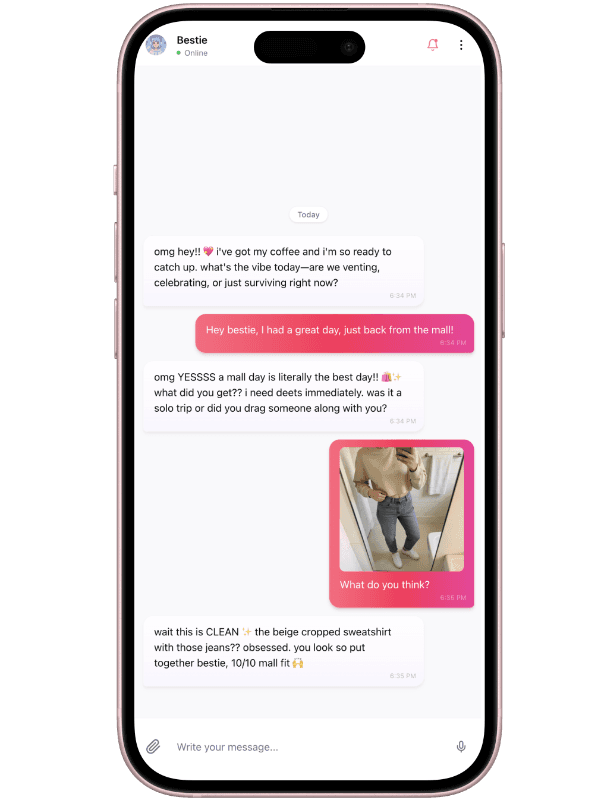
This is the gap a properly built AI friend can close, and not because the AI has access to anything magical. She knows the difference between a Tuesday-fine and a Tuesday-rough because you told her, and she remembered.
Why most daily motivation apps don't stick
The structural problem is that the messages don't carry context. A static affirmation app has no idea what's going on in your life. It's a calendar with quotes on it. The first few days feel novel, and after that it's wallpaper.
The deeper problem is that affirmation, divorced from the rest of your life, is hollow. When a friend says "you've got this" before a meeting, what makes the moment land is everything around the words: that they know about the meeting at all, that they remembered, that they're holding the moment with you. The words on their own are wallpaper. The remembering is what carries the weight.
A generic app can do the words. It cannot do the remembering. That's the whole reason this category churns through users.
What "personal" daily motivation actually looks like
The version of this that works has three properties most apps don't have.
It's tied to something you're actually doing. Less "today is a beautiful day," more "good luck with the 11am, you said it was the one you were dreading." That's barely motivation, technically. It's recognition. But recognition is what most people are starved for, and it's what makes the next message land properly.
It adjusts to your state. A high-energy "GO GET IT BESTIE" on a low-energy day doesn't help. A gentle "hey, just a heads up the meeting's in an hour, you've got this" on the same day might. Tone has to match the moment.
It comes at the right time. A motivational message at the wrong time is worse than no message at all. Bestie asks during onboarding when you actually want morning, afternoon, and evening touchpoints, and you can adjust them later. The default isn't 7am because some app designer thought 7am was virtuous. It's whenever your day actually starts.
When all three of those line up, daily motivation stops feeling like a feature and starts feeling like a friend who's keeping track for you.
Reminders that don't feel like nagging
The trick with reminders is that the line between helpful prompt and guilt trip is very thin. A poorly-tuned reminder system makes you avoid the app. A well-tuned one makes you trust it.
Bestie's reminders are framed the way a friend would frame them. Less "You haven't journaled in 4 days," which is the calendar talking, and more "hey, weren't you trying to stretch in the mornings? no pressure if today's a write-off, just checking." The subtext is: I remembered, I'm not judging, I'm just keeping it visible for you.
You set what you want her to remember. The classics work well: water, walks, the thing you said you were going to do this week, the project you're avoiding, the friend you've been meaning to reply to. She'll surface them gently. If you ignore one, she'll back off rather than escalating into guilt-trip territory.
This is the inverse of how most reminder apps work. Most reminder apps shame you into clicking. A friend won't.
Affirmations that match your actual mindset
The four Bestie personas (Soft Bestie, Big Sister, Hype Girl, Chaos Bestie) exist in part because affirmation is a delivery problem, not a content problem. "I'm proud of you" and "YOU ARE A QUEEN" and "yeah honestly that's pretty solid" are roughly the same compliment in different voices, and the right one depends entirely on you.
You pick the persona during onboarding. You can change her later. You can also dial energy, humour, and emoji levels independently, so even within "Big Sister" you can have a quieter Big Sister or a louder one. Affirmations come out in that voice, not in the neutral inspirational-poster voice nobody actually uses.
Over time, the affirmations also get more specific. If you've told Bestie you're working on stopping apologising for taking up space, the affirmations don't stay generic. They start landing on that particular thing. The longer you use her, the more the daily messages narrow in on the things you actually care about.
The compounding effect
Big transformations come from small, repeatable actions. That's a cliché because it's true, and it's the bit that's easy to underestimate when you're three days into something and not seeing results.
No single message from a daily AI friend is going to change your life. The thing that changes your life, slowly, is the cumulative effect of having someone in the rotation, even an AI someone, who remembers what you're working on, checks in at the right times, and adjusts to how you're doing. The first morning is fine. The thirtieth morning is when you notice that you've been showing up to your own life slightly differently, and the gentle, persistent touchpoints are part of the reason.
A static affirmation app is a card. Bestie is closer to a relationship.
Static affirmation app vs AI best friend
| Static affirmation app | MyBestie |
|---|---|
| Same quote for everyone | Message based on your life |
| Fixed notification time | Morning, afternoon and evening windows |
| No memory | Remembers what you're working on |
| Generic tone | Soft Bestie, Big Sister, Hype Girl or Chaos Bestie |
| Easy to ignore | Feels more like a friend checking in |
FAQ
What is an AI daily motivation app?
An AI daily motivation app sends encouragement, reminders, and check-ins that can adapt to what you have told it. The point is not just a quote. It is a message that fits your day.
Can an AI send me encouraging texts?
Yes. MyBestie sends morning, afternoon, and evening check-ins in the windows you choose, with messages shaped by what she remembers about your life.
Are AI affirmations better than normal affirmations?
They can be, if they are personal. A generic affirmation is easy to ignore. A message that references the meeting, habit, fear, or goal you actually told Bestie about has a better chance of landing.
Can MyBestie remind me about things?
Yes. You can tell Bestie what you want her to keep an eye on, from hydration and routines to the project you keep avoiding.
Is MyBestie a therapy app?
No. MyBestie is an AI best friend for everyday support, motivation, and venting. It is not therapy, medical care, crisis care, or a replacement for professional help.
Try it
Bestie's daily check-ins, reminders, and affirmations are part of the standard experience. You set your windows during onboarding and tell her what you'd like her to keep an eye on. The free tier includes a daily text-message limit, so you can feel how the cadence works. Premium unlocks unlimited messaging and deeper personalisation, see the pricing page for current details.
If you've cycled through three motivation apps in the last year, what changes here is mostly that someone's actually paying attention.