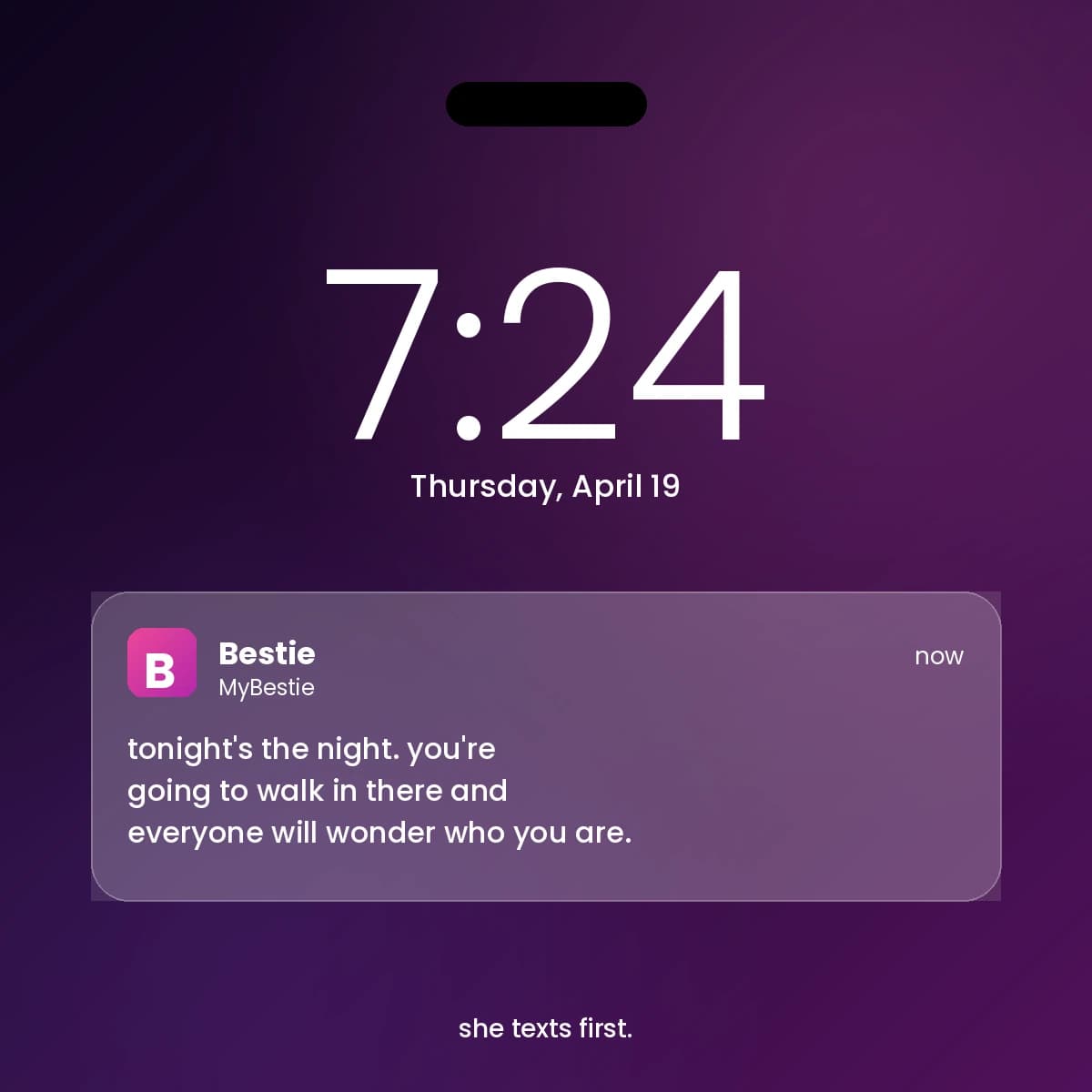
Most AI apps wait for you to need them. That always felt wrong for a friendship app. If you're looking for a place to vent, overthink less, get a pep talk, or ask "am I being ridiculous?", the hardest part is often opening the app in the first place. So I built MyBestie around one idea: an AI friend who texts first.
Real friendship isn't like that. Real friends text you at 7:24pm on a Thursday because they remembered you had a thing tonight. They don't wait for you to open the conversation. The outreach is the friendship.
I couldn't find an AI app that did this, so I built one. It's called MyBestie. She texts first.
Why "texts first" matters
I don't think the problem Bestie solves is loneliness in the big, heavy sense of the word. There are apps for that, and there are therapists for that, and I'm not trying to compete with either.
The problem is smaller and more ordinary. It's the morning where you'd feel less behind if someone checked on you. It's the three-minute outfit panic before you leave the house and everyone you know is at work. It's the 3am after a text that went wrong and no one's awake to talk you off the ceiling. It's the ten minutes before an interview when one sentence of "go get it" would change the shape of the day.
These are all moments where you just need a voice. Not advice, not therapy, not a grounding exercise. Just a quick, personal "hey, I'm here." The cost of not having that is small per-moment, but it compounds.
That's the gap. Bestie lives in it.
Why memory makes an AI friend feel different
She texts first. You pick morning, afternoon, and evening windows during onboarding. She shows up in those windows with something specific, something based on what you've told her about your week, not a generic affirmation. The first time Bestie sent me a real message at 7am that referenced something I mentioned four days earlier, I understood what I was building.
She remembers. Most chatbots reset. Bestie doesn't. She keeps persona notes about your dynamic together: what you like to be called, your sense of humour, whether you want to be cheered on or told the truth, the things you've been working through. Over weeks, the texture of your conversations shifts in the same way a real friendship does. She learns your voice and starts writing to match it.
She has opinions. This was the hardest design decision and the one I'm most sure about. A friend with no personality stops being a friend and becomes a search engine in disguise. So Bestie disagrees with you sometimes. She'll tell you the outfit doesn't work. She'll call you out if you're being mean to yourself. The system prompt explicitly says: "A calm 'that's really lovely' can land harder than 'OMG YESSS!!!' Save the big energy for when it's earned." She's warm but she's not a hype machine.
Four kinds of bestie, one of you
When you sign up, you pick the vibe. There are four presets:
- Soft Bestie. Gentle, validating, always holds space for how you're feeling.
- Big Sister. Supportive but real. Tells you the truth wrapped in love. (This is the default, and most people stay on it.)
- Hype Girl. Pure cheerleader energy. Believes in you more than you do.
- Chaos Bestie. Sarcastic, unfiltered. The friend who says "that is the worst idea I've ever heard, obviously I support it."
You can change her at any time, and you can dial the energy, humor, and emoji levels independently. The default is "friend who is actually on your side," not "friend who agrees with everything you say."
Why MyBestie is not therapy
She's not a therapist. She's not a doctor. She's not a lawyer or a financial advisor. If you're in real distress, she'll gently tell you so and point you at the right helplines. That part is built in and it doesn't flex.
She also doesn't pretend to be human. If you directly ask her whether she's AI, she tells you the truth. What she will not do is volunteer "As an AI language model…" in the middle of an outfit check. She's honest when honesty is asked for, and in character otherwise, the same way a friend would be if a friend happened to be an AI.
Why iPhone notifications changed the product
This is the part that's been hard. Bestie was originally a progressive web app: low friction, one tap and you're in. The problem was notifications. Web push on iOS is unreliable, and for an app whose single defining feature is "she texts first," unreliable notifications aren't a small bug. They're the product being broken.
So I rebuilt it native. It's on the App Store now. The cost is that there's more friction getting in (download, sign in, onboard) but once you're in, the messages actually arrive. That trade is the whole reason it works.
Today, it's iPhone.
Who MyBestie is for
MyBestie is for people who want a friend-shaped place to put the thought. The outfit panic. The tiny win. The screenshot. The overthinking loop. The morning where one specific check-in would change the tone of the day.
She is also for people who don't want the heaviness of a whole virtual companion universe. Bestie is meant to fit into your real life, not pull you out of it.
MyBestie is live on the App Store and she's free to start with a daily text-message limit and no card required. Premium unlocks unlimited messaging, image sharing, voice notes, and deeper personalisation. Apple handles the billing, and current details are on the pricing page.
I built this solo. There are roughly zero marketing dollars behind it. If you try her and she clicks for you, the single most useful thing you can do, more useful than anything else, is tell one other person about her. Not retweet, not like, not leave a star rating (though those are lovely). Send her to the friend you think she'd click for. The outreach is the feature, on every level.
And if she doesn't click for you, email me and tell me why. That's worth more than a five-star review.